
Table of Contents
- Self-Packing vs. Professional Packing Services: A Cost-Benefit Breakdown
- The DIY Packing Checklist for Residential Moves
- How to Organize Kitchen Items for Moving Without Professional Help
- Moving Box Rental Services and Eco-Friendly Alternatives
- Hybrid Packing Models: Partial Packing Services That Save Money
- Liability, Moving Insurance and the Risks of Packing Fragile Items Yourself
- Conclusion: Choosing the Right Packing Approach for Your Move
- Frequently Asked Questions
Last Updated: October 2, 2026
Self-Packing vs. Professional Packing Services: A Cost-Benefit Breakdown
Alternatives to professional packing services start with a simple question: what are you actually buying when you pay someone else to box up your home? Full-service packing is a labour and materials purchase, not a magic wand. The honest answer is that self-packing saves money while professional packing saves time, your back, and your security deposit. The right choice depends on which of those you have least of.
What You Actually Pay For With Full-Service Packing
Full-service packing covers three things: labour, materials, and liability. Crews arrive with corrugated boxes, bubble wrap, protective padding, and packing tape, then wrap, box, label, and load your household goods. The price reflects hours worked plus supplies consumed.
What most quotes bury is the service scope. Ask directly whether the estimate includes unpacking services, crating services for fragile items, and inventory management. A transparent provider answers all three before you sign. Consumer protection guidance on moving contracts is worth reading before you compare written estimates.
The Real Cost of DIY Moving
DIY moving trades money for time and physical risk. You buy your own packing materials, spend evenings and weekends packing, and carry the liability if something breaks.
The hidden cost is not the boxes.
| Factor | Self-Packing | Full-Service Packing |
|---|---|---|
| Out-of-pocket cost | Materials only | Labour plus materials |
| Time required | High, spread over weeks | Low, handled in one visit |
| Damage liability | Yours | Provider’s, per contract |
| Best for | Flexible timelines, tight budgets | Fixed dates, valuables, busy households |
The Time-Value Framework: When DIY Packing Becomes a Net Loss
| Scenario | Solo Packing Hours | Opportunity Cost at $30/hr | Professional Quote | Cheaper Option |
|---|---|---|---|---|
| 1-bedroom condo | 12-18 | $360-$540 | Typically higher than materials alone | Depends on wage |
| 2-bedroom home | 25-40 | $750-$1,200 | Varies by scope and region | Often professional at higher wages |
| 3-bedroom home with fragile items | 40-60 | $1,200-$1,800 | Varies by scope and region | Frequently professional |
If your opportunity cost is within about 20% of the professional quote, the tie-breaker is risk: professional packing shifts damage liability to the provider, which is worth real money on fragile or high-value items.
The framework also exposes the hybrid option. You do not have to choose all-or-nothing. Packing the low-risk rooms yourself and paying only for the kitchen, fragiles, and crating often lands you under both the full-DIY opportunity cost and the full-service quote.
The DIY Packing Checklist for Residential Moves
A working DIY packing checklist for residential moves follows a strict order: declutter first, pack rarely used rooms first, and label everything by destination room. Skipping the declutter step is why so many people pay to move things they will throw out on arrival.
- Book your moving date and confirm the moving timeline
- Declutter each room before packing it
- Order or collect moving supplies: boxes, tape, bubble wrap, padding
- Pack seasonal and storage items first
- Pack books and decor in small boxes to keep weight manageable
- Label every box with room and contents
- Reserve a clearly marked “first night” box per person
Number your boxes and keep a running list on your phone. If a box goes missing, you can tell your mover exactly which number to look for instead of describing contents from memory.
Room-by-Room Packing Supplies and Timeline
Different rooms need different supplies and different amounts of time. Getting this wrong is the single biggest cause of rushed, damaged packing.
| Room | Key Supplies | Time Estimate |
|---|---|---|
| Kitchen | Small boxes, paper, cell dividers | 1-2 days |
| Bedrooms | Large boxes, vacuum bags | Half day |
| Living room | Blankets, stretch wrap | Half day |
| Bathroom | Small boxes, sealable bags | 2-3 hours |
| Garage | Heavy-duty boxes, tape | Half day |
How to Organize Kitchen Items for Moving Without Professional Help
The kitchen is where DIY packing succeeds or fails. Pack plates vertically on edge, not flat in a stack, wrap each piece in packing paper, and use cell dividers for glassware. Boxes of dishes should never exceed roughly 15 kilograms, because heavy boxes are the ones that get dropped.
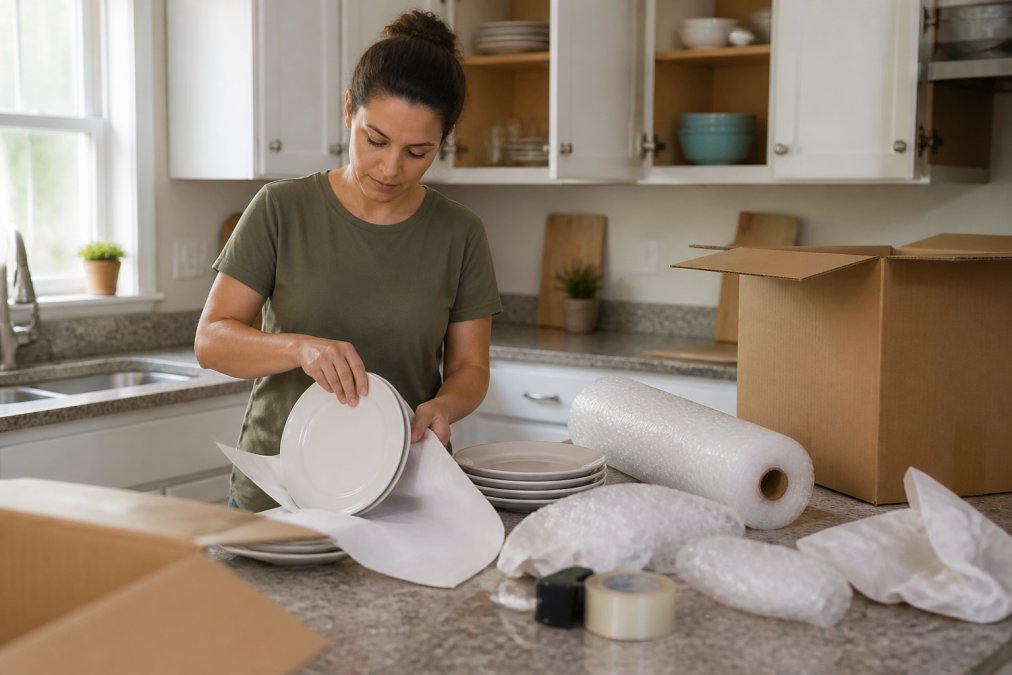
Work in this order:
GET YOUR FREE MOVING QUOTE Today →
- Empty and defrost the fridge at least 24 hours ahead
- Pack items you rarely use first
- Wrap glassware individually and stand it upright
- Tape liquids shut and bag them separately
- Label every box “Kitchen” plus the destination counter
Packing a box until it is full and heavy is the most common kitchen mistake. An overweight box splits at the bottom mid-carry, and the contents, not the box, take the damage.
Moving Box Rental Services and Eco-Friendly Alternatives
Moving box rental services supply reusable plastic crates delivered to your door and collected after the move. You skip the cardboard entirely, and many providers rent by the week, which suits short moves well.
How Crate Rental Actually Works
Most crate rental services follow the same model:
- You book a crate count based on home size (a common rule of thumb is roughly 8 to 12 crates per bedroom, plus 10 to 15 for a kitchen).
- Crates are delivered on a set date, usually a few days before your move.
- You pack and move them, then the provider collects them after your agreed rental window.
- Late returns typically trigger a per-crate daily fee, so confirm the return window before you book.
Crates stack and lock, which means no tape, no box assembly, and no collapsing boxes mid-carry. They are also weather-resistant, which matters if your goods sit on a porch or in a garage between loads.
What to Use Instead of Cardboard Boxes
- Plastic moving crates: sturdy, stackable, and weather-resistant for short-term storage
- Suitcases and duffel bags: ideal for clothing, linens, and shoes
- Laundry baskets: perfect for lightweight, awkward items
- Reusable totes: good for garage and utility items
- Free recycled boxes: grocery stores, liquor stores, and bookstores often give away sturdy boxes; check community buy-nothing groups and online marketplaces before you buy new
Cost and Sustainability Trade-Offs
Crate rental is not automatically cheaper than cardboard. The math depends on how long you need them and how many you use.
| Option | Upfront Cost | Reuse | Best For |
|---|---|---|---|
| New cardboard boxes | Pay per box | Usually one move | Long-term storage, one-way moves |
| Free recycled boxes | Free, time to source | One move | Tight budgets, flexible timelines |
| Plastic crate rental | Weekly rental fee | Hundreds of uses | Short moves, eco-conscious households |
| Suitcases and totes you own | Free | Indefinite | Clothing, linens, soft goods |
Crate rental wins on waste and convenience, not always on price. If your move is short and local, the weekly rental often beats buying new boxes. If you need storage for months, cardboard or owned totes usually cost less.
Hybrid Packing Models: Partial Packing Services That Save Money
The highest-value hybrid split is simple: you handle soft goods, the crew handles fragile, heavy, and high-value items. That one decision captures most of the savings with none of the exposure.
Mansa Movers builds custom moving estimates around exactly this kind of split, with an all-inclusive hourly rate that does not add fees for stairs, the truck, or kilometers. If you want the middle path, ask for it by name.
Liability, Moving Insurance and the Risks of Packing Fragile Items Yourself
Here is the nuance most guides skip: liability coverage usually changes depending on who packed the box. When a professional crew packs an item, the provider generally carries more responsibility for it. When you pack it yourself, the provider can often limit liability for contents you packed, even if the box was handled correctly.
Photograph every high-value item after packing and before the truck is loaded. Timestamped photos settle most damage claims quickly, whichever party packed the box.
Conclusion: Choosing the Right Packing Approach for Your Move
The question is not whether you can pack everything yourself. It is whether the hours you save are worth more than the hours you spend. For a flexible schedule and a tight budget, self-packing plus a box rental service works well. For fixed dates, fragile valuables, and busy households, hybrid packing captures most of the savings without the risk.
Frequently Asked Questions
What are the most cost-effective alternatives to hiring professional packers?
The cheapest route is packing yourself with free or low-cost moving supplies like repurposed boxes from local retailers, then hiring movers only for loading and transport. Hybrid models cut costs further: you pack non-fragile household goods such as books and clothing, while professionals handle fragile items and crating services. Moving box rental services offer reusable plastic crates on a rental basis, which reduces the cost of buying corrugated boxes and packing tape. For a realistic comparison, request a moving estimate that separates packing labor from transport so you can see exactly where your money goes.
Can I hire partial packing services to save on moving costs?
Yes. Many full-service packing companies offer partial or hybrid options where the crew handles only high-risk items: mirrors, artwork, electronics, and large furniture. You handle the rest. This keeps labor-intensive work off your plate while avoiding the full cost of a complete pack. Ask for a service scope that lists exactly which rooms or items are covered, and confirm whether unpacking services are included. A transparent provider will break down the quote by task so you can adjust the scope to fit your budget.
What are the risks of packing your own fragile items for a long-distance move?
The main risk is liability coverage. Most moving insurance policies limit or exclude damage claims for boxes the customer packed themselves, because the company cannot verify how the contents were protected. If a box you packed arrives with broken dishes, the carrier may deny the claim. For high-value items like pianos or antiques, professional crating services and proper protective padding are worth the cost. If you do pack fragile items yourself, document their condition with photos before the move and use double-walled corrugated boxes with adequate cushioning.