
Last Updated: October 31, 2026
Quick Summary
Transparent moving pricing means every charge appears in your written estimate before moving day, with no additions after the truck is loaded. The benefits are that your budget holds, your comparison is fair, and your final invoice matches what you signed.
- A transparent quote lists labor, travel, packing materials, access conditions, and extras as separate line items.
- A binding estimate locks the price for the listed services, while a nonbinding estimate moves with actual hours.
- Build your budget from the highest credible quote, not the lowest, and add a contingency amount.
- Ask every mover in writing: Is this binding or nonbinding, what is excluded, and what triggers a price change?
- Every charge on the final invoice should trace back to something you saw, discussed, or signed before moving day.
Table of Contents
- What Transparent Moving Pricing Actually Means
- How a Moving Cost Estimate Is Calculated
- Hidden Moving Fees to Check Before You Sign
- How to Compare Moving Quotes Fairly
- Moving Budget Planning Around the Final Invoice
- The Benefits of Transparent Moving Pricing for Different Move Types
- Get Your Free Moving Quote From Mansa Movers
- Frequently Asked Questions
What Transparent Moving Pricing Actually Means
Transparent moving pricing is a pricing model where every charge appears in your written estimate before moving day, with no additions after the truck is loaded.
A transparent quote lists labor, travel, packing materials, access conditions, and extras as separate line items, so you can read, question, and compare it against other quotes on equal terms.
Transparent moving pricing is not the same as cheap pricing. It is a quote you can audit. A mover who hides stairs fees is not cheaper than one who lists them. They are just delaying the bad news.
The benefits of transparent moving pricing show up in three places: your budget holds, your comparison is fair, and your final invoice matches what you signed. Below, we break down how quotes are built, what to check before signing, and what to do when the numbers move.
How a Moving Cost Estimate Is Calculated
A moving cost estimate is a written projection of the hours, distance, and materials a move will take, converted into a price. Professional movers build it from a survey of your home, not from a phone guess.
The Inputs Behind Every Quote
Every credible quote rests on the same inputs. If a mover cannot explain these, ask why.
- Volume: how much you own, measured in cubic feet or by inventory list
- Distance: local kilometers or long-distance routes
- Labor: number of movers and estimated hours
- Access conditions: stairs, elevators, long carries, parking distance
- Packing services: boxes, materials, and time to wrap fragile items
- Specialty items: pianos, safes, antiques, large furniture
- Additional services: storage, junk removal, appliance disconnection
A professional assessment in person or by video catches what a phone call misses. The staircase with the tight turn. The piano that needs a ramp. The condo elevator booking window.
Skip that step and the cost estimate becomes a guess, corrected on moving day at your expense.
Binding vs Nonbinding Estimates
A binding estimate locks the price for the listed services. If the move takes longer than predicted, the mover absorbs the difference. A nonbinding estimate is an educated projection; the final price moves with actual hours and conditions.
Neither type is automatically better. Binding suits moves with known scope. Nonbinding suits moves where volume is uncertain.
What matters is that you know which one you signed. Ask directly: “Is this binding or nonbinding?” Get it in writing.
Hidden Moving Fees to Check Before You Sign
Hidden moving fees are charges that exist in the contract but not in the headline quote. They surface after you have committed. Before signing, scan the agreement for these:
- Stairs and elevator fees per flight or per floor
- Long carry charges when the truck cannot park close
- Fuel surcharges added as a percentage
- Travel time billed for the drive to and from your home
- Packing materials marked up beyond the quote
- Specialty item fees for pianos, safes, or gym equipment
- Storage charges if delivery is delayed
- Cancellation fees and deposit forfeiture terms
- Valuation coverage sold as an add-on rather than included
Watch out: a quote dramatically lower than every other bid usually means one of these fees is missing from the page, not from the move.
Ask each mover to confirm in writing which of these are included. The answer tells you more than the total.
How to Compare Moving Quotes Fairly
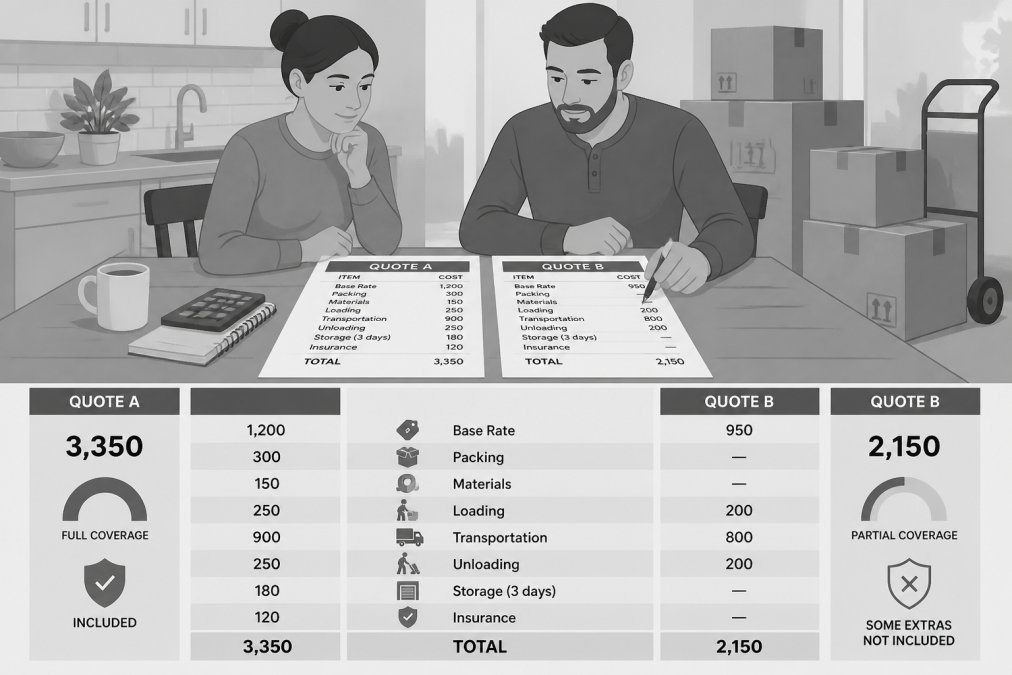
Comparing moving quotes fairly means comparing identical scopes, not identical totals. Two quotes for the same home can differ by hundreds of dollars simply because one includes packing and the other does not. You can also compare moving estimates side by side.
Build a Scope Sheet First
Before you open a single quote, write down what you actually want moved and what services you expect. This becomes your scope sheet, and every quote gets measured against it. Include:
- Room-by-room inventory, including closets, storage lockers, balconies, and garage contents
- Access details: floor number, elevator availability and booking windows, stair flights, parking distance to the door
- Services wanted: packing, unpacking, disassembly and reassembly, appliance disconnection, storage, junk removal
- Delivery window and any date flexibility
- Specialty items by name: piano, safe, pool table, oversized artwork, gym equipment
A mover who quotes without this information is guessing. A mover who quotes against it is pricing a defined job.
The Four-Pass Quote Audit
Run every quote through the same four passes. This is the repeatable method that separates a comparable quote from a misleading one.
Pass 1, Quantities. Does the inventory list attached to the quote match your scope sheet item for item?
Pass 2, Services and exclusions. Mark each service on your scope sheet as included, excluded, or optional.
Pass 4, Price-change conditions. Confirm in writing whether the estimate is binding or nonbinding.
Compare Accuracy, Not Just the Total
A low total from a quote with missing line items is not a better deal; it is a deferred cost. Score each quote on four dimensions:
| Dimension | What to Compare | Red Flag |
|---|---|---|
| Scope match | Inventory and services versus your scope sheet | Missing rooms, boxes, or services |
| Estimate type | Binding or nonbinding, stated in writing | Verbal assurance only |
| Exclusions | Explicit list of what is not covered | Vague or absent exclusions |
| Price-change conditions | Named triggers and rates | “Price may vary” with no detail |
A quote that scores well on all four is safer than one that wins on total alone. For practical tips on weighing the quotes you have collected, contact us for a free moving quote.
GET YOUR FREE MOVING QUOTE Today →
Ask every mover the same three questions in writing: Is this binding or nonbinding? What is excluded? What triggers a price change and at what rate? Compare the answers, not the totals.
Questions That Expose a Weak Quote
A short set of questions will tell you more than the headline number:
- Is the inventory list attached, and does it match my scope sheet?
- Are stairs, long carry, and elevator fees listed or excluded?
- Is fuel, travel time, and mileage itemized or bundled?
- Are packing materials and labor included, and at what quantity?
- Is valuation coverage included, and at what level?
- What are the deposit and cancellation terms?
- Is there a delivery window, and what happens if it slips?
- Who do I contact if the final invoice differs from this estimate?
An itemized cost breakdown lets you compare quote accuracy, not just the bottom line. A mover who lists everything and prices it honestly is safer than one who quotes low and explains later.
Moving Budget Planning Around the Final Invoice
Moving budget planning works best when you plan around the final invoice, not the first quote. Set aside a buffer for the gap between estimate and actual, because some moves legitimately run longer than predicted. The bigger risk is not knowing what to do when the invoice arrives higher than the estimate.
Build the Budget With a Buffer
A practical approach many of our customers use:
- Build your budget from the highest credible quote, not the lowest.
- Add a contingency amount for delays, extra materials, or access issues.
- Confirm in writing what triggers extra charges and at what rate.
- Keep the signed estimate and inventory list with you on moving day.
- Compare the final invoice line by line against the estimate.
The contingency is not a prediction. It is a cushion for the legitimate variables on most moves: an extra flight of stairs, a longer carry than surveyed, added packing for items not ready, or a shifted delivery window.
When the Final Invoice Differs From the Estimate
This is the moment transparent pricing is tested.
Step 1, Ask for the reason in writing. Before you pay, request a written explanation of each line that changed.
Step 2, Compare against the signed estimate and inventory list. Put the estimate, the inventory list, and the final invoice side by side.
Step 5, Use the dispute path in the contract. Check the agreement for the mover’s complaint and dispute process, and follow it in writing.
Paying the full balance before the unload is complete can remove your leverage if items arrive damaged. Confirm the payment terms in the contract first, and never pay an unexplained charge without a written explanation.
What a Transparent Quote Should Have Prevented
A transparent quote does not guarantee the final invoice matches to the dollar, because moves involve real variables. What it should guarantee is that every charge on the final invoice traces back to something you saw, discussed, or signed before moving day. If a charge cannot be traced, that is the signal to pause and ask questions before paying.
The Benefits of Transparent Moving Pricing for Different Move Types
The benefits of transparent moving pricing change with the type of move.
Residential moves. An all-inclusive hourly rate means stairs, truck, and kilometers are already in the number. You budget once.
Long-distance moves. Distance-based pricing with itemized fuel and travel time lets you see exactly what the kilometers cost.
Commercial relocations. Downtime is the real cost.
Full-service moves with storage or junk removal. Bundled services priced as line items keep the total visible from the start.
Across all of these, the pattern is the same.
Get Your Free Moving Quote From Mansa Movers
The real test of any quote is whether the final invoice matches it. That is the standard we hold ourselves to.
Mansa Movers builds every estimate on an all-inclusive hourly rate with no fees for stairs, truck, or kilometers. We handle packing, storage, junk removal, and long-distance moves, and we treat your possessions with royal care. Every quote is custom to your home and your inventory.
Request a written estimate before you commit to anything. You can also see pricing and request a transparent quote.
Frequently Asked Questions
What are the benefits of transparent moving pricing?
Transparent moving pricing lets you see the full cost of your move before booking, so you can budget accurately and avoid surprise charges on moving day. An all-inclusive rate that covers stairs, equipment and kilometers makes quotes easier to compare line for line. It also reduces the risk of a final invoice that exceeds your estimate, which is the most common complaint people raise about movers.
What hidden moving fees should I look for in a moving estimate?
Check for stair and elevator charges, long carry fees when the truck cannot park close, fuel surcharges, travel time, packing materials, appliance disconnect fees and cancellation charges. Ask whether the quote includes valuation coverage or whether that is extra. A quote that lists these items up front is transparent; one that mentions them only in fine print is not.
How can I compare moving quotes fairly?
Compare like with like: confirm each quote covers the same inventory, the same packing services and the same access conditions such as stairs and parking distance. Ask whether the estimate is binding or nonbinding, and check what happens if your move runs longer than expected. Comparing quote accuracy, not just the total, shows which mover is more likely to honor the number they gave you.
Can movers charge extra for stairs or moving equipment?
Some movers do add stair fees, long carry charges or equipment surcharges on top of the quoted rate. Ask before booking whether stairs, elevators, dollies and blankets are included or billed separately. An all-inclusive hourly rate that covers these items removes the risk of a higher bill once the crew arrives and sees your building.
Most movers will promise a fair price. Fewer will put every charge on one page before you sign. Ask for the itemized quote, compare it line by line, and hold every mover to the same standard. Get started with Mansa Movers and get a written, all-inclusive quote you can plan your move around.
