
Last Updated: November 12, 2026
Quick Summary
To pack fragile items safely, wrap each piece individually, stand plates on edge rather than flat, and fill every gap so nothing shifts. Line boxes with generous cushioning on the bottom and top, then seal and shake-test each box before it leaves the room.
- Use sturdy small and medium corrugated boxes so fragile loads stay light enough to carry with two hands.
- Stand plates on their edge, never flat, because flat stacks crack under their own weight.
- Stand glasses upright and add extra padding around the stem, the weak point that snaps when a box shifts.
- Double-box items for parcel shipping, since sorting and drops put more shock into a box than a move does.
- Write FRAGILE on the top and at least one side, and keep fragile boxes at the top of the stack.
Table of Contents
- Start With the Right Boxes and Packing Materials for Fragile Items
- How to Pack Dishes for Moving Without a Single Crack
- How to Pack Glassware for Moving So It Arrives Intact
- How to Pack Mirrors for Moving and Other Large Glass Pieces
- Packing Oddly Shaped and High-Value Fragile Items
- Moving Versus Shipping: Why the Packing Rules Change
- Packing Mistakes That Break Fragile Items and How to Avoid Them
- Book Professional Packing Help for Your Fragile Items
- Frequently Asked Questions
Start With the Right Boxes and Packing Materials for Fragile Items
The best ways to pack fragile items start long before you touch a single plate. They start at the hardware store, choosing the right box and the right padding. Get those two things right and the rest of the job gets much easier.
Flimsy boxes and thin padding cause most breakage, and that holds true whenever a kitchen or china cabinet is packed for a move.
Here is what you need before you start:
- Sturdy corrugated cardboard boxes in small and medium sizes
- Bubble wrap for glass and ceramics
- Packing paper for wrapping and void fill
- Protective foam sheets for flat glass and mirrors
- Foam peanuts or inflatable cushioning for gaps
- Packing tape and a marker
- FRAGILE labels for every box
Smaller boxes matter more than people think. A big box full of dishes gets heavy fast, and heavy boxes get dropped. Keep fragile loads light.
If you want the full walkthrough from start to finish, our guide on how to pack fragile items for moving breaks the whole process into steps you can follow box by box.
How to Pack Dishes for Moving Without a Single Crack
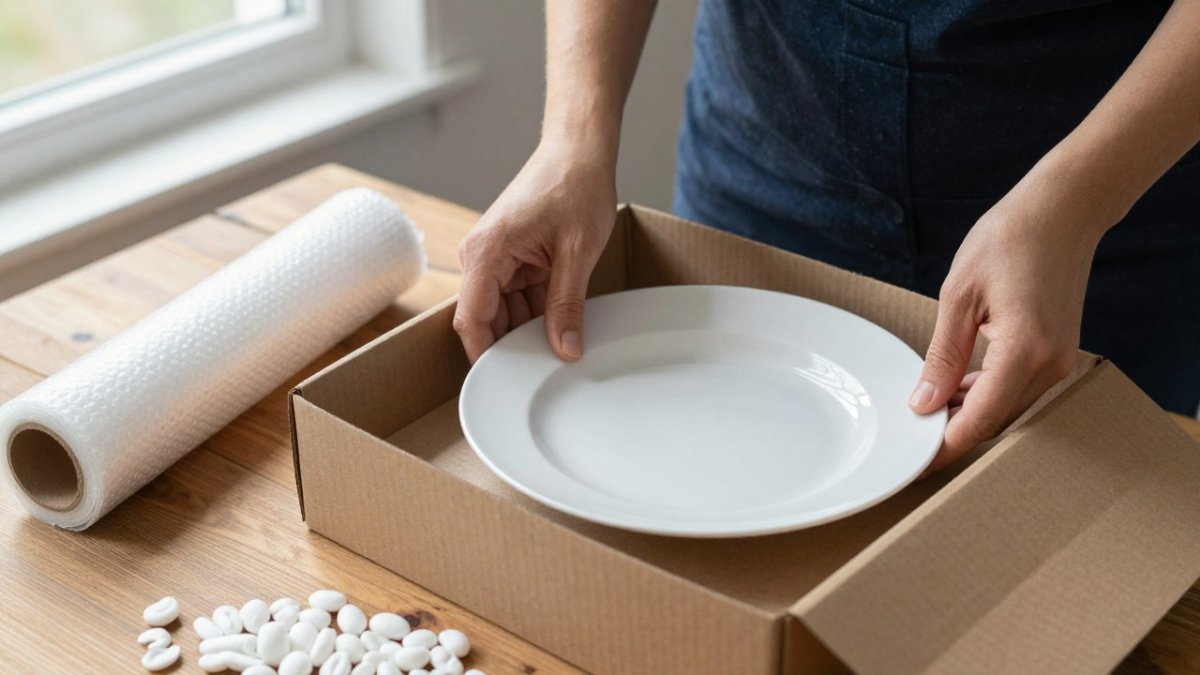
The short answer to how to pack dishes for moving is simple: wrap each piece, stand plates on edge, and never let two items touch. Most cracks come from movement, not from the box itself.
Here is the order we use:
- Line the bottom of the box with crumpled packing paper.
- Wrap each plate completely in paper, then add a layer of bubble wrap for fine china.
- Stand plates on their edge, never flat. Flat stacks crack under their own weight.
- Place a sheet of cardboard between layers.
- Fill every gap with paper or foam.
- Seal the box and mark it FRAGILE on the top and sides.
Cups and bowls get the same treatment. Stuff a little paper inside each cup, wrap it, and pack them rim down. Bowls nest well with paper between them.
How to Pack Glassware for Moving So It Arrives Intact
Wine glasses and stemware break in a different way than plates. The stem is the weak point, and a box that shifts even slightly will snap it.
Wrap each glass completely, then add extra padding around the stem. Stand glasses upright in the box, not on their sides. Use cell dividers if you have them, and fill the gaps with foam peanuts.
Aim for a thick layer of cushioning on the bottom and top of the box so impacts are absorbed before they reach the glass.
For crystal and very thin glass, wrap in tissue paper first, then bubble wrap. Two thin layers beat one thick one.
How to Pack Mirrors for Moving and Other Large Glass Pieces
Mirrors, framed art, and glass tabletops need a flat, rigid setup. The goal is to stop the glass from flexing at all.
Start with a layer of protective foam or cardboard on both faces of the mirror. Tape it in place so it does not slide. Then build a cardboard sandwich around the whole piece, taping the edges.
For a large mirror, stand it upright in the truck and strap it to the wall. Laying it flat invites weight on top of it. Small mirrors can go in a box with paper packed around the edges.
Paintings get the same treatment, with extra care at the corners. Corner protectors are cheap and save frames.
Packing Oddly Shaped and High-Value Fragile Items
Oddly shaped and high-value pieces are where generic packing advice fails. A lamp, a framed print, a ceramic vase, and a box of jewelry each fail in a different way, so the packing method has to change with the item.
Artwork and framed prints. Treat the frame and the glass as two separate risks. Tape an X of painter’s tape across the glass so shards stay contained if it breaks, then wrap the whole piece in packing paper, add foam or cardboard to both faces, and build a cardboard sandwich around the edges. Corner protectors are inexpensive and help protect frames.
Mirrors and glass tabletops. These need rigid support on both faces so the glass cannot flex. Foam or cardboard on each side, taped in place, then a cardboard sandwich.
Lamps and lamp bases. Remove the shade and pack it separately in its own box with paper around the rim.
Electronics. Use the original box and foam inserts if you still have them; they are engineered for that item. If not, wrap the device in anti-static material if available, pad the screen or glass face with foam, and double-box for shipping.
Ceramics, pottery, and irregular keepsakes. Wrap fully, then build the box around the item rather than forcing the item into a standard box. Fill every void so the piece cannot shift when you shake the box gently.
Jewelry and small valuables. These should travel with you, not in the truck or a parcel. The same goes for documents, heirlooms, and anything you could not replace.
For high-value or irreplaceable pieces, take photos before packing and note any existing damage. That record matters if you ever need to make a claim. For pieces you are not comfortable packing yourself, professional packing can be the safer choice.
Moving Versus Shipping: Why the Packing Rules Change
Packing for a move and packing for shipping are not the same job. A moving truck rides for hours. A parcel gets sorted, stacked, and dropped, sometimes more than once.
That is where double-boxing comes in. For shipping, you pack the item in an inner box with cushioning, then place that box inside a larger outer box with more cushioning between them. The box-in-box method absorbs impact that a single box cannot.
Shipping also means the box may sit in a cold truck or a hot warehouse. Tape needs to hold through both. Use good packing tape, not masking tape.
For moves, the box stays in your hands or ours the whole time. That is why a single well-padded box usually does the job.
| Situation | Box Setup | Cushioning | Key Risk |
|---|---|---|---|
| Local move | Single sturdy box | Generous padding on all sides | Movement in the truck |
| Long-distance move | Single box, strapped upright | Extra padding for vibration | Vibration over hours |
| Shipping by parcel | Double-boxed | Substantial padding in both boxes | Drops and sorting impact |
| High-value item | Custom box, braced | Foam plus cardboard | Flex and pressure |
Packing Mistakes That Break Fragile Items and How to Avoid Them
Most fragile-item damage traces back to a handful of failure points, and almost all of them can be caught before the box is sealed.
The shake test. Seal the box, then lift it and shake it gently. If you hear or feel anything move, the packing has failed and you need more fill.
Item-to-item contact. Two wrapped items touching is still two items touching. Cracks often start where a plate edge meets another plate edge. Use dividers, cardboard sheets between layers, and enough fill that nothing touches its neighbor.
Weak or oversized boxes. A box that bulges will not close flat, and the pressure cracks what is inside. A box that is too large for its load lets contents slide.
No cushioning on the bottom. The bottom takes the first hit when a box is set down.
Under-taped seams. A box that opens mid-carry drops everything. Tape the bottom and top seams fully, not just a single strip across the middle.
Missing or unclear labels. Movers cannot be careful with what they cannot see. Our guide on how to label moving boxes shows a simple system that keeps fragile boxes out of the heavy stack.
Stacking weight on fragile boxes. Heavy boxes on top of a fragile box is a crack waiting to happen. Keep fragile boxes at the top of the stack or in a separate area.
Packing when tired or rushed. Most breakage happens in the last hour of a packing day. Pack fragile items first, when you are fresh, and leave clothes and books for the end.
Run the shake test on every fragile box before it leaves the room. It takes seconds and catches the mistakes that a visual check misses.
Book Professional Packing Help for Your Fragile Items
Some jobs are worth handing off. If you have a full china cabinet, artwork, or a piano, professional packing removes the risk and the stress.
Mansa Movers offers professional packing as part of its residential and commercial relocation services. Our pricing is an all-inclusive hourly rate that covers stairs, the truck, and kilometers, so there are no hidden fees for those items. An all-inclusive estimate can also help you plan packing support for a North York move, where N&N Brothers Moving Company may be a useful point of comparison.
Wondering what the service actually includes? Read what to expect from full-service packing and moving before you decide. If you are weighing your options, we also explain the alternatives to professional packing services so you can compare fairly. And if protection is your main concern, here is how insured movers protect your belongings during a move.
For high-value pieces, mention them when you request a quote so the estimate reflects what you need moved.
Fragile items break for predictable reasons: thin boxes, missing padding, and movement. Fix those three and most of the risk goes away. When you would rather not take the chance, Mansa Movers can pack, protect, and move your valuables with our all-inclusive hourly rate, professional handling of high-value items, and a custom estimate built around your home. Get started with Mansa Movers and move with one less thing to worry about.
Frequently Asked Questions
What is the best way to pack fragile items for moving?
Wrap each fragile item individually with bubble wrap or packing paper, then place it in a sturdy corrugated cardboard box with a thick layer of cushioning on the bottom, sides, and top. Fill empty spaces with void fill so nothing shifts, seal the box, and mark it FRAGILE. For extra protection on high-value pieces, use the box-in-box method: pack the item in a smaller inner box, then cushion that box inside a larger outer box.
How do you pack dishes and glassware so they do not break?
Stand plates and dishes on edge, never flat, and wrap each one in packing paper before placing them in the box. Fill the gaps with crumpled paper. For glassware, stuff a little tissue paper inside each glass, wrap the outside, and pack glasses upright. Keep boxes to a manageable weight, around 10 to 15 kilograms, so they are easy to lift and less likely to be dropped.
Should fragile items be packed vertically or horizontally?
Plates, dishes, and mirrors should travel vertically, standing on edge, because a flat stack concentrates weight and pressure in the center and cracks easily. Glasses and stemware should stay upright so the stems and bowls are not bearing load. Boxes themselves should be packed so heavier items sit at the bottom and lighter, more delicate pieces go on top.
How much padding should you put in a box with fragile items?
Use a substantial layer of cushioning on all six sides of the box: bottom, top, and all four walls. This multi-layer approach absorbs shock from drops and shifting during the move. Crumple packing paper or use bubble wrap, foam peanuts, or inflatable cushioning to fill every empty space, then give the closed box a gentle shake. If anything moves inside, add more void fill before sealing.
